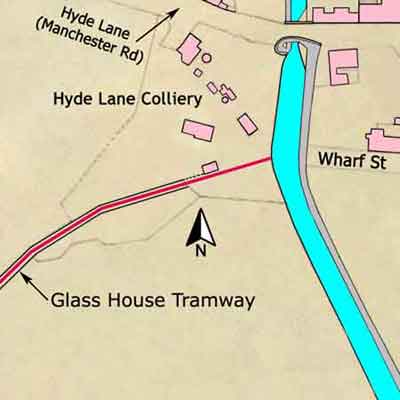
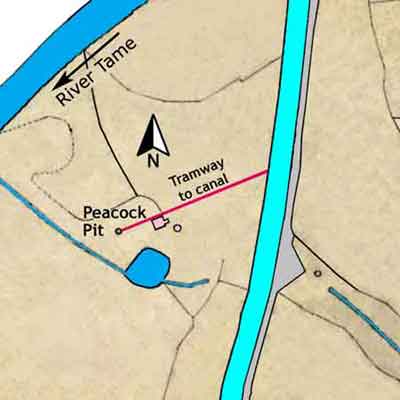
Tithe Maps of Hyde Colliery & High Field Colliery
The tithe maps for Hyde and High Field Collieries show that both were occupied by Thomas Brown and William Clayton, the former being the Resident Engineer for the Peak Forest Canal Company. High Field Colliery was situated a short distance to the south of Hyde Colliery on the other side of Hyde Hall. The land on which both collieries stood was then owned by Edward Hyde Clarke, the half brother of Hyde John Clarke (Captain Hyde John Clarke RN), and he was resident at Hyde Hall.
The tithe map showing High Field Colliery states that it was, indeed, a colliery but a careful examination of the map suggests that this may not have been the case and that it might have been used as a pumping station for Hyde Colliery. The map shows a narrow water channel between the colliery and the offside of the Peak Forest Canal with a small building beside it. This channel does not appear wide enough to accommodate a boat and it may have been a drainage channel to release water pumped out of Hyde Colliery into the canal.
If this supposition is correct, then the building beside the channel may have been an engine house and the circular structure at the end of the channel may have been a shaft with a sump at the bottom and a water pump at the top. Because the pump does not appear to be integral with the engine house a linkage mechanism would have connected the engine to the pump.
The shaft would have contained a standpipe and water from Hyde Colliery would have collected in the sump. At the commencement of the pump upstroke a one-way inlet valve at the top of the standpipe automatically opened and during the upstroke water was drawn into the pump cylinder. When it reached the top of its stroke the inlet valve automatically closed and, simultaneously, the one-way outlet valve at the bottom of the cylinder opened. During the downstroke, the water in the cylinder was discharged through the outlet valve to flow into the drainage channel and then into the canal. At the bottom of its stoke the outlet valve closed and the inlet valve opened and the cycle was repeated.
This method of draining mines was common and a nearby example was at Denton Colliery where Hulme's Pit was used as a pumping station to discharge water from Denton Colliery into the river Tame. Hulme's Pit began life as a coalmine but after Denton Colliery opened and was connected to it underground, its function was changed to that of a pumping station.
The Hulme's Pit pump raised water from a depth of 420 feet and it is recorded that it removed eight gallons of water per stroke at six strokes per minute. That is 2,880 gallons/hour or 12.86 tons/hour.