
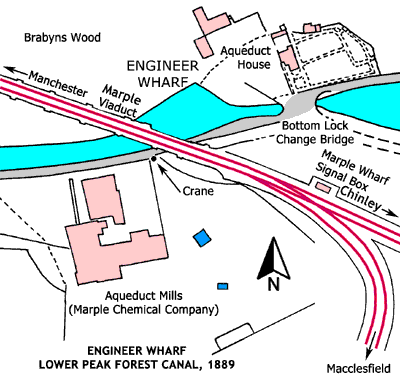
Engineer Wharf is situated on the north side of the canal, close to the foot of Marple Locks, and it contained the canal company's workshops dating from 1825. These included a blacksmith's forge and a carpenter's workshop where replacement lock gates were made. The Tithe Map of 1850 shows the wharf prior to the construction of Marple Viaduct by the Sheffield and Midland Railway Company, which carried their line over the river Goyt as well as over the wharf.
At this time all the land shown on this portion of the map was owned by the Peak Forest Canal Company and occupied by the Manchester, Sheffield and Lincolnshire Railway Company.
The buildings to the south of the canal were known as Aqueduct Mills by 1889. Originally, the two-storey building facing the canal was the Queen's Hotel. In the early years of the 19th century, this hostelry was used by fly-boat passengers travelling on the Peak Forest Canal as well as the Macclesfield Canal after it opened in 1831. Passengers were able to enjoy the facilities while they waited for horses to be changed but its trade diminished rapidly with the coming of the railway.
Subsequently, the Marple Bone-Dust, Glue and Size Company moved onto the site, equipped with disintegrators, bone-dust sieving machines, wooden boiling cisterns and glue coolers. Later, glue and size were still being manufactured here under the name of the Marple Chemical Company. Later, the site became a Calico Mill and nowadays it is a business park.
Calico is a type of cotton fabric, typically unfinished, often with flecks of cotton seeds visible, or unbleached plain white in a suitable condition to be dyed or printed on. The name is of 16th century origin, originally called ‘Calicut’ after the town of Kozhikode in the state of Kerala, south-western India. However, the fabric can be traced back to the 15th century. Variations of cotton fabric include muslin, gauze, canvas and cheese cloth.
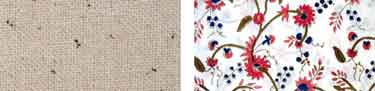
Left: Unfinished fabric. Typically it is a strong, plain-woven cotton fabric made from unbleached and not fully processed cotton.
This means that the fabric has not been cleaned or treated with any chemicals and as a result it may contain imperfections.
Right: Finished fabric printed with small repeating patterns often of a floral nature.
Brabyns (Brabins) Coal Mine
Nathaniel Wright, a business partner of Thomas Brown, purchased the Brabins estate on the north side of Marple Locks in Lower Marple in 1800.
The following year he leased a neighbouring strip of land from John Bradshawe Isherwood, which enabled him to develop a mine with either a navigable cut or railway connection to the canal.
This was probably a drift mine and in the event a short tramway was constructed to the canal.
The route of this is uncertain but it may have connected with the canal at or near to Engineer Wharf. According to Farey, this mine was still being worked in 1811.
Nathaniel Wright died in Jul 1818, aged 55 years.
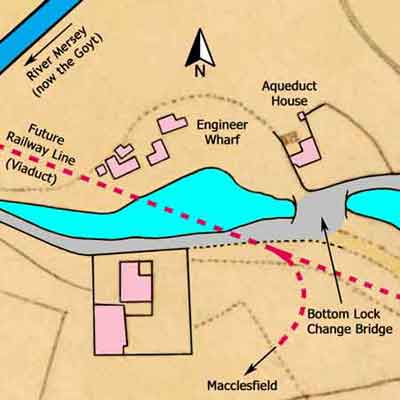
Engineer Wharf
Lower Peak Forest Canal
Grid Ref: SJ 956 900
Tithe Map: 1850, Ref: EDT 262/2
Courtesy: Cheshire Archives & Local Studies
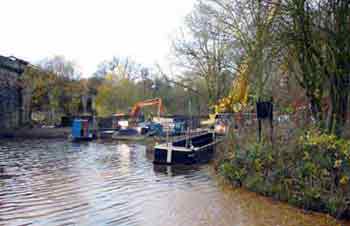
Engineer Wharf, Nov 2006.
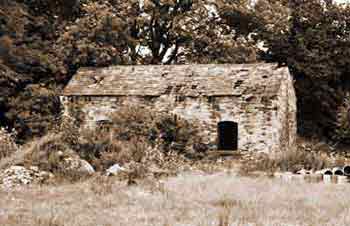
The carpenter's shop on Engineer Wharf, Jul 1978.
By this time it was the only building left standing on the wharf and it is understood that the blacksmith's shop once stood to the left of it.
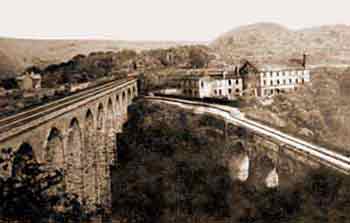
Marple Aqueduct on the right and Marple Viaduct on the left, early 20th century.
The viaduct crosses over the canal at an acute angle and Bottom Lock Change Bridge can just be seen behind the viaduct. Aqueduct House stands on the far left and Aqueduct Mills are on the right.
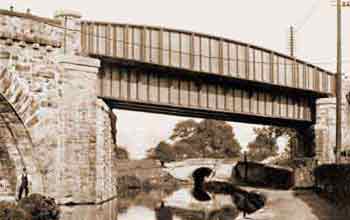
Marple Viaduct opened in 1865 and it consists of 12 stone arches and one plate girder bridge at its eastern end that carries the line over the Peak Forest Canal.
The two-storey building facing the canal was originally the Queen's Hotel.
The plate girder bridge at the eastern end of Marple Viaduct, 1920s.
Immediately beyond the bridge, out of sight on the left, is Engineer Wharf where the company's workshops were located.
Bottom Lock Change Bridge is in the centre background. There is no towpath through this bridge, so horses had to be unhitched before boats could pass under it.
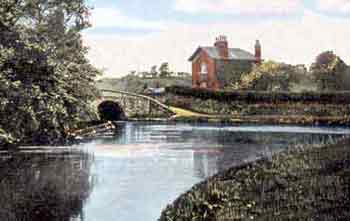
Aqueduct House, 1906.
The first house on this site was built in 1804 for £130 and it was the dwelling of the Wharfinger. It is understood that it was subsequently rebuilt as the residence of the Chief Engineer of the Peak Forest Canal Company but later it was downgraded for the senior craftsman employed at Engineer Wharf.
