
Dukinfield Wharf, the first on the Peak Forest Canal, was situated in a heavily industrialised area dominated by cotton mills. In addition to mills there was an iron works and the famous fireclay works of John Hall & Son whose kilns were built alongside the canal. The river Tame threaded its way through the mills, on its way to Stockport, and Dukinfield Wharf was on the eastern bank of the river. Hereabouts, the river forms the boundary between the counties of Lancashire and Cheshire as well as the boundary between Ashton-under-Lyne and Dukinfield.
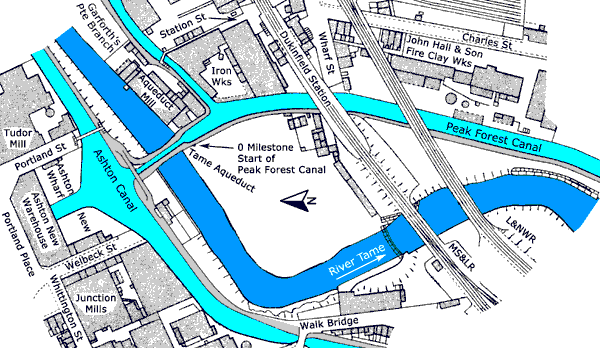
Dukinfield Wharf, 1907.
The Peak Forest Canal commences at the southern end of the Tame Aqueduct, the aqueduct being built by the Ashton Canal Company. Adjoining the aqueduct was Aqueduct Mill, which stood on the corner of Garforth's Private Branch (Alma Street Private Branch). This was one of several private branches on the Peak Forest Canal but it is the only one to survive and it has now been fully restored by Portland Basin Marina. In 1888 it accessed Garforth's works and wharf as well as Eli Cryer & Sons' mills and wharfs and Bown's boiler works. Originally, the branch extended through an archway of a railway viaduct for a few yards to stop at the bottom of Alma St. Around the turn of the 20th century, it was shortened and a drydock was built at the end. In 2007 this feature was excavated and restored for use by Portland Basin Marina.
Garforth's Private Branch » Garforth
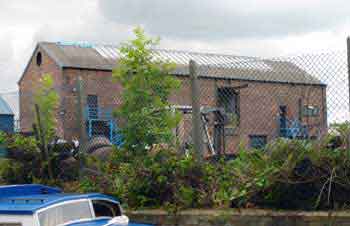
The Bown family business was founded here in the early part of the 19th century and today it is known as J Bown & Co (Dukinfield) Ltd. This business is a world leader in the manufacture of heads for pressure vessels, pipe caps, expansion bellows and compensation pads.
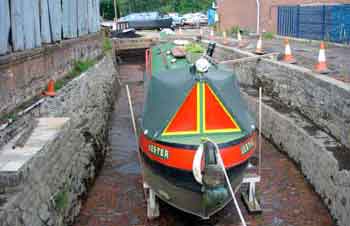
The newly restored drydock at Portland Basin Marina, Jul 2007.
Courtesy: G & S Holding of Portland Basin Marina.
J Bown & Co (Dukinfield) Ltd, Jul 2007.
Further along, the Manchester, Sheffield and Lincolnshire Railway (Stalybridge Branch) crosses the canal on an iron bridge. This bridge was built in 1845 and restored in 1978. It is worthy of note because the platforms of Dukinfield Station once extended over the canal but these were demolished in Apr-Jun 1968.
Just beyond this bridge, Wharf St climbs up from the canal, crosses over King St in the centre of Dukinfield, to terminate at Crescent Rd. The offices and works entrance to John Hall & Son stood at the bottom of Wharf St.
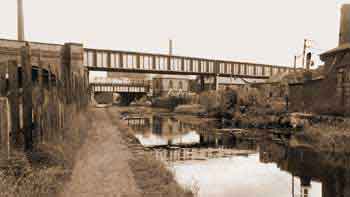
On the far side of this bridge there was formerly a long iron girder viaduct for the London and North Western Railway (Saddleworth Branch), which was demolished in 1973.
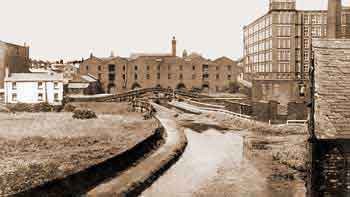
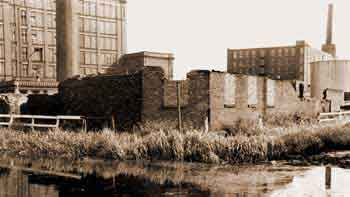
Portland Basin, Ashton-under-Lyne, seen from Dukinfield Station, 1962.
The buildings, from left to right, are Junction Mills, Canal Office (white), Ashton New Warehouse and Tudor Mill, while the tower belongs to Ashton Swimming Baths. The demolished building on the right, where the canal narrows to cross the Tame Aqueduct, was Aqueduct Mill (or Dukinfield Mill) and Garforth's Private Branch runs alongside it. Ashton Junction is at this end of the aqueduct and it is where the Peak Forest Canal starts. Portland Basin is on the other side of the humped-towpath bridge.
Garforth's Private Branch Canal has since been restored and it is now a marina.
Aqueduct Mill, Jun 1965.
The remains of Aqueduct Mill (or Dukinfield Mill) are in the centre, while Tudor Mill and Cavendish Mill stand in the background on the far side of both the river Tame and the Ashton Canal, left and right, respectively.
Garforth's Private Branch runs alongside Aqueduct Mill.
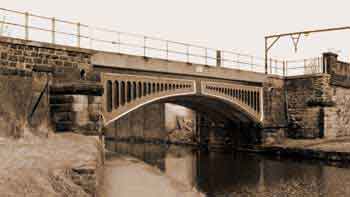
The Manchester, Sheffield and Lincolnshire Railway bridge, Mar 1986.
This view, looking towards Ashton-under-Lyne, shows the bridge after the demolition of Dukinfield Station and the removal of the platforms over the canal.
Looking toward Ashton-under-Lyne, Jun 1965.
The plate girder bridge in the foreground carries the London and North Western Railway (Saddleworth Branch) over both the canal and the Fireclay Works of John Hall & Son.
The bridge in the background is the same as the one shown on the photo to the left and it carries the Manchester, Sheffield and Lincolnshire Railway (Stalybridge Branch) over the canal. In this view the platforms of Dukinfield Station are still in situ.
The building to the right of latter bridge is the office of John Hall & Son at the bottom of Wharf St.
The fireclay works of John Hall & Son stood on a strip of land between the canal and Charles St and a plate girder railway bridge passed over the top of it. The company was founded in 1792, some two years before construction of the Peak Forest Canal commenced, and it manufactured a wide range of fire bricks and sanitary ware. It stood near a rich bed of fireclay and it had its own clay mine, known as the Dukinfield Fireclay Mine. In 1896, seven men were involved in clay mining, five underground and two on the surface. The works remained open until late 1967 and it was demolished around Easter 1969.
In 1911 the company began receiving raw materials from their Clarence Fireclay Mine in Adlington transported by boat from their wharf on the Macclesfield Canal near Bollington. This wharf was located between Sugar Lane Bridge and Clarence Mill. Materials were delivered to Dukinfield via the Macclesfield and Peak Forest Canals and at Marple Junction there was a toll office where records were made of passing traffic. By the 20th century, canals were in decline and this traffic provided a welcome source of income for the two canals. Records made at the Marple toll office illustrate the magnitude of this trade.
Over the period 3 Feb 1926 to 6 Jun 1935 there were 932 deliveries of fireclay, coal and shale from the company fireclay wharf near Bollington to the Fireclay Works at Dukinfield, a distance of 15 miles and 33 chains. The total quantity of of materials transported amounted to around 16,776 tons, based on an average boatload of 18 tons. Eight boats were used for this traffic, which is summarised in the three tables below.
| Boat | Captain | No. of Journeys |
|---|---|---|
| Benefactor | L Mayers | 281 |
| Benefactor | J Mayers | 8 |
| Benefactor | P Turner | 6 |
| Julia | L Mayers | 114 |
| Julia | J Mayers | 17 |
| Julia | P Turner | 3 |
| Jupiter | L Mayers | 90 |
| Jupiter | Unknown | 1 |
| No. 8 | L Mayers | 67 |
| No. 8 | J Mayers | 1 |
| Protection | L Mayers | 29 |
| Protection | J Mayers | 14 |
| Protection | P Turner | 3 |
| Retaliation | L Mayers | 14 |
| Retaliation | J Mayers | 10 |
| Tyne | L Mayers | 52 |
| Weaver | L Mayers | 219 |
| Weaver | P Turner | 3 |
| Boat | No. of Journeys |
|---|---|
| Benefactor | 295 |
| Julia | 134 |
| Jupiter | 91 |
| No. 8 | 68 |
| Protection | 46 |
| Retaliation | 24 |
| Tyne | 52 |
| Weaver | 222 |
| Captain | No. of Journeys |
|---|---|
| L Mayers | 866 |
| J Mayers | 50 |
| P Turner | 15 |
| Unknown | 1 |
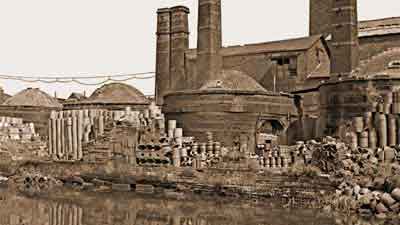
The Fireclay Works of John Hall & Son, just before it was demolished in 1969.
The kilns were circular with a domed roof and were known as beehive kilns. They were of the down-draught type where the heat of combustion was drawn down through the kilns by chimneys.
Dukinfield Fireclay Works » John Hall & Son
