Dukinfield Hall, Dewsnap Basin, Dewsnap New Pit & Astley Deep Pit
Introduction
The section of the Lower Peak Forest Canal between Dog Lane Bridge and the former Dewsnap Basin is steeped in history.
Here, two historic buildings were situated on the offside of the canal and these were Dukinfield Hall, home of the Duckenfield family, and its adjoining chapel, known as Old Hall Chapel.
Duckenfield Family
The Duckenfield family were lords of Dukinfield from the 13th century until the mid-18th century. The most famous member of the family was Lieutenant Colonel Robert Duckenfield (1619-1689) who was a member of the Puritan faith.
He distinguished himself in battle for Oliver Cromwell's parliamentary cause. He took part in the defence of Manchester in 1642 and he was appointed the commander of Cromwell's forces in the North West in 1648.
In 1651 he commanded the forces that secured the Isle of Man and in 1653 he was appointed to Cromwell's Nominated Assembly, also known as the 'Parliament of the Saints' or 'Barebones Parliament'.
The Nominated Assembly first met on the 4 Jul 1653 but it had a life of less than six months. There were 129 representatives for England and Wales, five for Scotland and six for Ireland.
He also became a county High Sheriff. Lieutenant Colonel Robert Duckenfield died on the 18 Sep 1689 and was buried in the graveyard of St Lawrence's Church at nearby Denton,
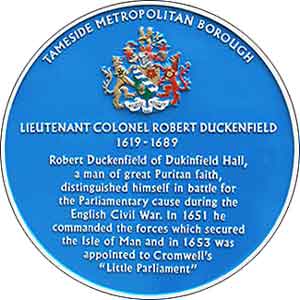
his grave having a stone memorial (there is also a blue plaque on the front of Dukinfield Town Hall in his honour). Over the years the family amassed much land and property throughout Cheshire
and by the mid-17th century they owned the whole of Dukinfield, which is named after the family.
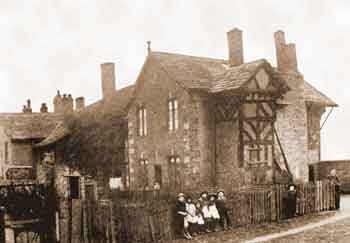
Dukinfield Hall
This hall, dating from the late 16th or early 17th century, was rectangular in plan with gabled projections and the rooms contained stuccoed ceilings.
Formerly, it was a half-timbered building but parts of this were later encased by brick walls. It is possible that the surviving hall was built on the site of an earlier building.
Eventually it was divided into separate dwellings following which it was subjected to years of neglect.
By the end of World War II it was in a dilapidated condition and at this point it was declared unfit for human habitation.
The National Trust was approached to see if they would take it but they declined and as a result it was demolished in 1950/51.
Old Hall Chapel
This chapel dates from the late 16th or early 17th century and it was the domestic chapel of Dukinfield Hall.
In 1872 an extension, in the form of a large transept, was opened on the west side for use as a Congregational Chapel.
Further alterations were made in 1891/93 designed by the architects, Worthington and Elgood of Manchester.
In the 20th century the transept became unused and dilapidated and in 1980 it was severely damaged by a fire that spread to the original chapel.
The transept was demolished in 1981 leaving only the remains of the original chapel still standing. These remains were so poor that Historic England funded an archaeological recording exercise.
The chapel remains are listed Grade II*, List Entry No. 1356422, and it is on the Heritage at Risk Register.
Left, Dukinfield Hall, and right, Old Hall Chapel, viewed from a pond between the hall and Globe Ln.
From John Aikin's, A Description of the County from Thirty to Forty Miles Round Manchester, (1795).
Dukinfield Hall, c.1900.
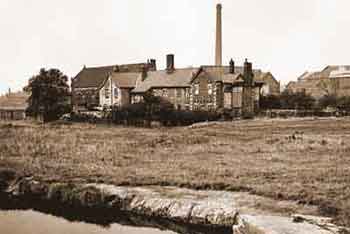
Left, Old Hall Chapel, and right, Dukinfield Hall, viewed from Well (or Dukinfield Hall) Bridge, 1940s.
The building in the background on the far right is part of the former carriage and waggon works of the Great Central Railway Company.
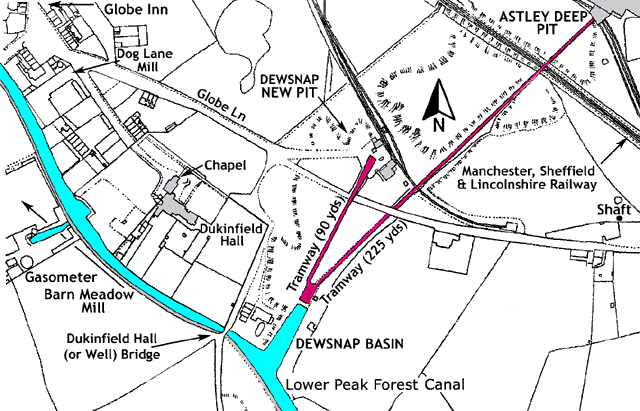
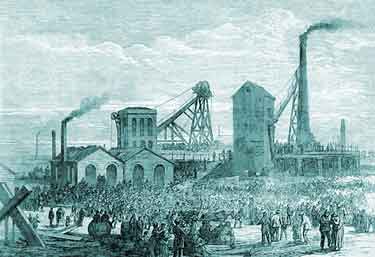
Dewsnap Basin, Dewsnap New Pit & Astley Deep Pit, 1875.
For Tithe Maps of Dewsnap Basin click here » Tithe Maps
Dukinfield Hall Spinning Company
This cotton-spinning mill was situated on the offside of the canal close to Dog Lane Bridge.
Young's Mill and Well Bridge Bleach Works
Situated on the offside of the canal between Dukinfield Hall and the canal was Young's Mill. This was also known as Old Hall Mill and later it was owned by Henry Bannerman & Sons Ltd. While cotton mills in this locality were
mainly concerned with cotton spinning, it is understood that Young's Mill also had a weaving shed. A short distance further along is Well (or Dukinfield Hall) Bridge and on the east side of Dunkirk Ln was
Well Bridge Bleach Works, which had its own wharf and was owned by the Manchester, Sheffield and Lincolnshire Railway Company for a while.
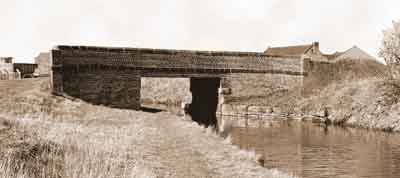
Well (or Dukinfield Hall) Bridge, looking towards Ashton-under-Lyne, Jan 2007.
Dukinfield Hall Bridge was built to carry an ancient right of way between Dukinfield and Mottram in Longdendale over the canal. This runs from Astley St and Globe Square onto Wellbridge Rd and then over the
canal where its name changes to Dunkirk Ln. It then runs by the river Tame for nearly ¾ mile and then back up over the canal at Newton Hall Bridge (No. 4).
Such rights of way have existed for many centuries and they were formerly considered to be the only safe way to travel, since they avoided bogs and other obstacles.
Dewsnap Basin, Dewsnap New Pit and Astley Deep Pit
Next to the bleach works was the Dewsnap Basin Loading Stage, originally operated by the Dunkirk Colliery Company. By 1850, Dewsnap Basin was newly built and was still awaiting connections to coal mines.
The original Dewsnap Colliery was still extant but soon its site was to be replaced by the Dewsnap Sidings of the Manchester, Sheffield and Lincolnshire Railway Company. This coal mine was connected to Dog Lane Basin by a
tramway running down Globe Ln. Dewsnap New Pit (aka Dewsnap Pit) had been sunk, as a replacement, 173 yards away from Dewsnap Basin and Astley Deep Pit (aka Astley Pit) had been sunk 467 yards away, off King St, on the
north side of the Manchester, Sheffield and Lincolnshire Railway line. Eventually, there were tramway connections from both these pits to Dewsnap Basin where boats were loaded with coal.
For the Dunkirk Coal Company and others click here » Dunkirk Coal Co
The shaft of Dewsnap New Pit was sunk in 1845/46 and it was situated on the opposite side of Globe Ln to the canal. The pit was connected to Dewsnap Basin by means of a short tramway on an inclined plane that
crossed over Globe Ln on a bridge. This was a self-acting inclined plane in which descending full tubs were used to haul up empty ones under the action of gravity. In coal-mining vernacular, this type of plane was
known as a 'jig' and a 'jigger' (sometimes 'jagger') was a workman who attended the brake at the top of the plane to prevent tubs from running away.
In 1896, Dewsnap New Pit was employing 347 underground workers and 48 surface workers. The manager was Richard Clay and the under-manager was William Hyde. The Great and Roger seams were worked and the types of
coal mined were household and steam. The date of closure of Dewsnap New Pit is uncertain but it is likely that it was around the same time as that of Astley Deep Pit, which was in 1901.
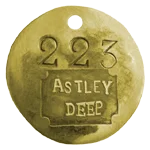
Astley Deep Pit was larger than Dewsnap New Pit and its shaft was sunk in 1847. As the name implies, coal was gained from a great depth, recorded as 686½ yards. It was situated on the opposite side of Globe Ln
but, as stated above, at a greater distance from the basin than Dewsnap New Pit. It was connected to Dewsnap Basin by means of a tramway on an inclined plane that passed below Globe Ln.
This was a self-acting inclined plane and its mode of operation was the same as the Dewsnap New Pit inclined plane.
In 1896, this pit was employing 487 underground workers and 123 surface workers. The manager was Richard Clay and the under-manager was Alfred Taylor. The Black, Cannel and Peacock seams were worked and the types of
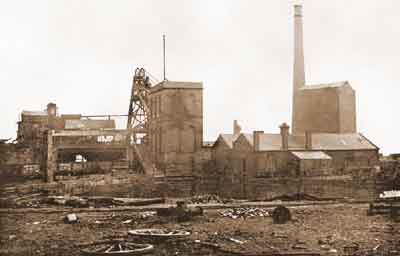
coal mined were gas, household and steam. Astley Deep Pit closed on the 7 Aug 1901 after a life of 54 years, which was far below estimates.
At this time, the Company Mining Engineer was William Mackenzie Reynolds, who was a Member of the Federated Institute of Mining Engineers, and he lived on Cheetham Hill Rd, Dukinfield.
Following closure of these pits, operations to fill the shafts, together with those of Dog Lane Pit and Victoria Colliery, commenced in Sep 1903 and the work was undertaken by Underwood Brothers, Contractors.
In the case of Dewsnap New Pit, the work was done to prepare the site for the new Carriage and Waggon Works of the Great Central Railway Company. When this works was completed it was 28 acres in extent, including Dewsnap Sidings.
Left: Astley Deep Pit at the time of the disaster in 1874.
Right: Astley Deep Pit during demolition after closure in 1901. The upcast shaft headgear has already been demolished, leaving the downcast shaft headgear.
Astley Deep Pit Disaster, 1874
On the 14 Apr 1874 it was the scene of a disaster in which 54 men and boys lost their lives to leave 18 survivors who were either injured or entombed until they were rescued. A previously 'burnt' tunnel was
temporarily being repaired when the roof collapsed to release pockets of gas, generally known as 'firedamp'. As the men were working with open flame lamps the roof collapse triggered a huge explosion.
It had long been a widespread practice to make workings safe by deliberately burning off any firedamp present. The miner, whose job it was to do this highly dangerous and spectacular work, was known
as a 'penitent'. He would enter the workings before the shift started dressed in rags soaked in water. He carried a lighted candle on the end of a long pole with which to ignite any
gas while lying face down on the floor. It was his appearance dressed in wet rags that gave rise to the name 'penitent'.
In the case of Astley Deep Pit, the workings had just been 'burnt' and were considered to be safe to work in using open flame lamps. However, the roof collapse allowed firedamp to enter the tunnel and so cause the
fatal explosion.
The pit disaster of 1874 was preceded by a smaller explosion that occurred 4 years, 1 month and 11 days earlier on the night of the 3 Mar 1870. In this explosion nine miners lost their lives and it occurred in the
Black Mine (seam) as a result of a shot being fired by one of the deceased, Solomon Cambridge.
For Black Mine (seam) explosion click here » Black Mine
Barn Meadow Mill
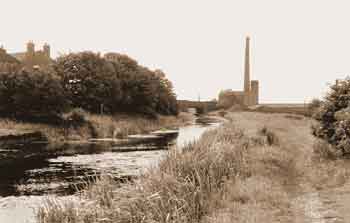
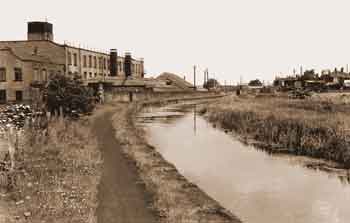
On the towpath side of the canal the principal building was the large Barn Meadow Mill, opened in 1835, which had its own private branch canal. By 1918 the building was closed as a mill and converted to an
electric accumulator works, known as the Tudor Accumulator Works and latterly owned by Messrs Courtney Pope. The building was demolished in the 1970s but the name of the accumulator works lives on in the
Tudor Industrial Estate.
Barn Meadow Mill, looking SE, Jun 1965.
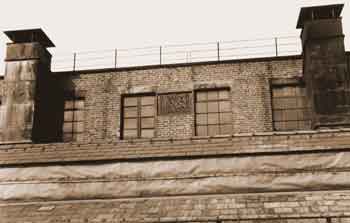
Barn Meadow Mill, looking NW, Jun 1965.
Barn Meadow Mill, Jun 1965.
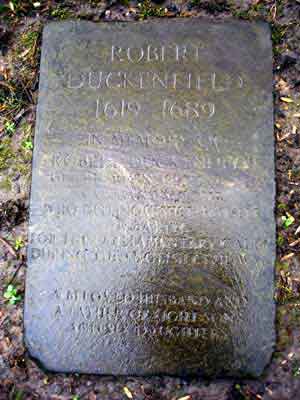
Robert Duckenfield's ledger stone at St Lawrence's Church, Denton
ROBERT
DUCKENFIELD
1619-1689
IN MEMORY OF
ROBERT DUCKENFIELD
OF THE DUCKENFIELD ESTATES
A VALIANT SOLDIER
WHO DISTINGUISHED HIMSELF
IN BATTLE
FOR THE PARLIAMENTARY PARTY CAUSE
DURING THE ENGLISH CIVIL WAR
A BELOVED HUSBAND AND
A FATHER OF EIGHT SONS
AND SIX DAUGHTERS
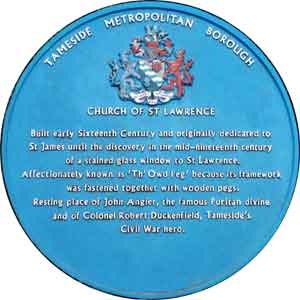
Robert Duckenfield's blue plaque at St Lawrence's Church, Denton
TAMESIDE METROPOLITAN BOROUGH
CHURCH OF ST LAWRENCE
Built early Sixteenth Century and originally dedicated to
St James until the discovery in the mid-19th century
of a stained glass window to St Lawrence.
Affectionately known as 'Th' Owd Peg' because its framework
was fastened together with wooden pegs.
Resting place of John Angier, the famous Puritan divine
and of Colonel Robert Duckenfield, Tameside's
Civil War hero.
Robert Dukenfield's blue plaque at Dukinfield Town Hall
TAMESIDE METROPOLITAN BOROUGH
LIEUTENANT COLONEL ROBERT DUCKENFIELD
1619-1689
Robert Duckenfield of Dukinfield Hall,
a man of great Puritan faith,
distinguished himself in battle for
the Parliamentary cause during the
English Civil War. In 1651 he
commanded the forces which secured
the Isle of Man and in 1653 was
appointed to Cromwell's
'Little Parliament'
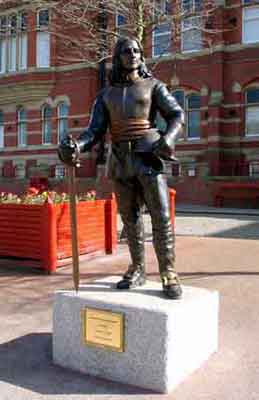
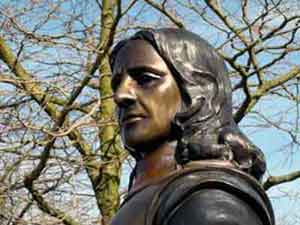
Statue of Lieutenant Colonel Robert Duckenfield
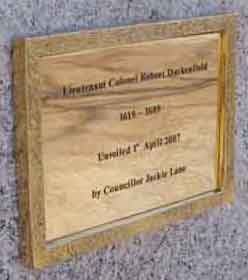
The statue is located outside Dukinfield Town Hall and the plaque reads:
Lieutenant Colonel Robert Duckenfield
1619-1689
Unveiled 1st April 2007
by Councillor Jackie Lane
Soldiers of Colonel Edward Montagu's Regiment of Foote performed a march-past at the statue unveiling ceremony.
This was led by an officer on horseback and it included flying standards and drums and a volley of musket fire.