
Hulme's Pit (or Holmes Pit) was one of the oldest in the Denton area and it was situated on Hulme's Ln (Holmes Ln) alongside the river Tame. It is reputed to have opened in c.1730 but it is known that it was operated by the Fletcher family (Denton Colliery Company) who eventually used it as a pumping station to drain water from their mine workings.
The workforce for the pit lived in the immediate vicinity. There were cottages on either side of it by the river but the largest concentration was at the hamlet of Beat Bank adjoining Stockport Rd. By the 1840s the Trustees of the late Ellis Fletcher, owners of Ellis Pit (Denton Colliery) and Hulme's Pit, were major landowners in the vicinity, as well as around Arden Mill on the Bredbury side of the river Tame. Some miners working at Hulme's Pit, for example Thomas Sackfield who operated the weighing machine, lived for a while at Mill Field House adjacent to Arden Mill.
It is known that there were several shallow mines in the vicinity of Hulme's Pit, alongside the river Tame, and it is likely that there were also drift mines into the side of Beat Bank at points where coal seams came to the surface. Due to its location by the river Tame, there was always a serious problem of drainage and in its early days this would have imposed a severe limitation on deep mining by the capacity and expense of mine-pumping equipment. In its early days it is likely that men and horses used primitive pumps to overcome the drainage problem.
The first viable engine was the atmospheric engine introduced by Thomas Newcomen in 1712 but there is no evidence for the use of an engine of this type at Hulme's Pit. The next important development was the steam engine (known as a beam engine), introduced by James Watt in 1776, and it is likely that the engine installed at Hulme's Pit was a Watt beam engine or more correctly a Boulton & Watt beam engine, as Matthew Boulton was the business partner of James Watt.
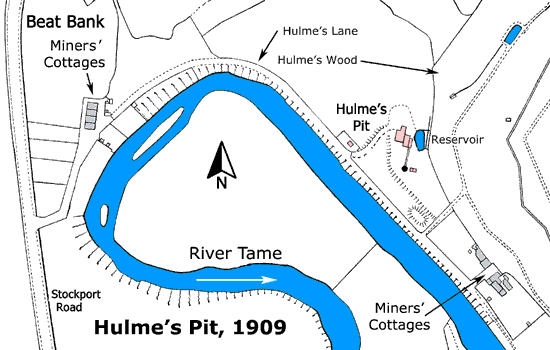
It is not known when the beam engine was installed but there is a record of its existence in 1834. Prior to the pit being taken over by Denton Colliery, it was used for both winding (men and coal) and for pumping water out of the mine. Latterly, it was only used for pumping purposes, draining Denton Colliery, and coal to fire the two Cornish boilers was supplied by horse and cart from Denton Colliery. Cornish boilers differ from Lancashire boilers in that they have one large flue (or fire tube) containing the fire while Lancashire boilers have two large flues (or fire tubes).
Water was raised from a depth of 420 feet at a boiler pressure of five pounds per square inch. In the early 1920s it was recorded that it removed eight gallons of water per stroke at six strokes per minute. It worked 4½ hours a day, 7 days a week and it consumed three tons of coal per week. This means that it raised 4,730,400 gallons of water from the workings of Denton Colliery every year for a coal consumption of 156 tons.Hulme's Pit closed in 1929/30, at the same time as Denton Colliery, and the beam engine was scrapped in the early 1930s. All the buildings associated with the pit were subsequently demolished, as were the cottages by the river, the last to go being the row of four cottages near Stockport Rd that survived until after World War II. Similarly, some of the cottages at Beat Bank were demolished, leaving the farmhouse, barn and a row of derelict cottages that survived until after World War II.
Surviving stone foundations of the pit were excavated in the 1970s and a wildlife pond was created alongside Hulme's Ln. It is interesting to note that a few of the shrubs in the cottage gardens by the river have survived and sometimes it is possible to see them in flower.
 |
 |
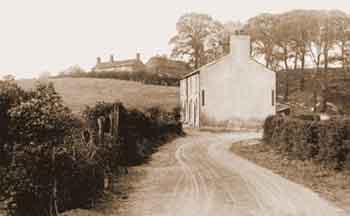
The row of miners' cottages on Hulme's Ln near Stockport Rd, c.1910. In the background, top left, is Beat Bank House at Leather’s Fold in the hamlet of Beat Bank. The building behind Beat Bank House is a barn. Stockport Rd is off the picture to the left. In 1939 the Home Guard dug trenches in front of Beat Bank House. |
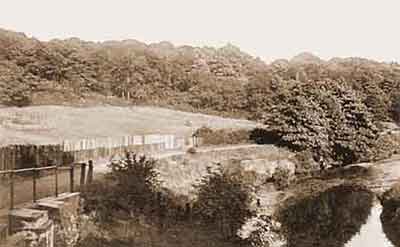
The approach to Hulme's Pit from Stockport Rd, early 20th century. |
 |
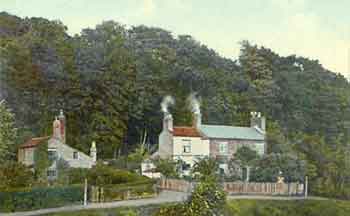 |
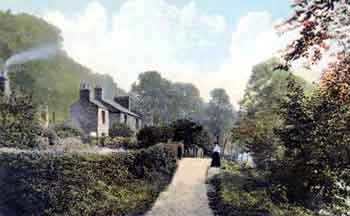
Miners' cottages on Hulme’s Ln, located at Hulme's End, early 20th century. The river Tame is just off the picture to the right. |
Miners' cottages on Hulme’s Ln, located at Hulme's End, early 20th century. This view is looking across the river Tame from the Bredbury side of the river. |
For more details about Hulme's Pit use the following menu:
