
Rationale
Denton Colliery Tramway was built as a feeder from Denton Colliery on Stockport Rd, Denton, to the colliery sidings and coal wharf situated in North Reddish where there was a connection
to the London & North Western Railway (Stockport and Guide Bridge Line). Its purpose was to transport coal to North Reddish for distribution by both rail and road transport.
Track, Steam Locomotives and Rolling Stock
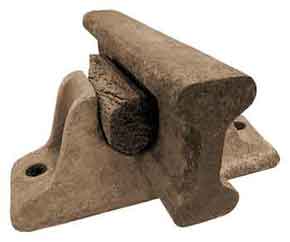
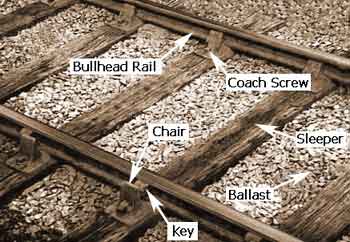
The single track was laid to a gauge of 4 feet 8½ inches using edge ('I' section) bullhead rails supported by cast-iron chairs with keys (NoteThe keys used on Denton Colliery Tramway were wooden wedges.) driven between the side of the rail and the chairs.
In turn, the chairs were secured onto wooden sleepers with coach screws. The sleepers were embedded in ballast (crushed stone) and set at a close spacing (typically 2 feet 6 inches)
in order to maintain the gauge of the rails and to distribute the loading of trains as they passed over them. Rails were joined together by means of fishplates bolted to the ends of abutting rails.
Normally, a fishplate had four bolt holes, two for each rail.
When the tramway opened, wrought-iron bullhead rails were used in its construction. Rails of this type had become increasingly available since 1805 when they were first introduced by the Bedlington Ironworks near Durham. The first steel rails were introduced by Robert Forester Mushet in 1857 (after the tramway opened) for use at Derby Midland Railway Station. There is some anecdotal evidence that the rails on the tramway were never replaced by steel rails.
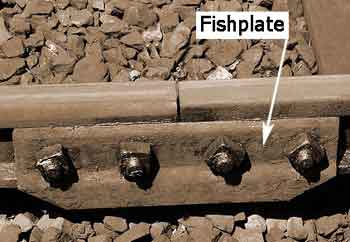
Above left: Fishplate used to bolt the ends of two rails together.
Above: Bullhead rail supported on a cast-iron chair and secured to it with a key (wooden wedge)*.
Left: Bullhead rails in situ.
*In cross section, the head of a bullhead rail is slightly larger than the foot to make it stronger.
Steam haulage was employed on the tramway but there are no records of the number of locomotives in service over the years. However, it is known that by the late 19th century three 0-4-0 saddle tank locomotives were in use called 'Denton', 'Nancy' and ‘Liverpool’.
At a meeting held on the 2 Dec 1929 it was decided to voluntarily wind up the Denton Colliery Co Ltd. Consequently, it is likely that both Denton and Liverpool were scrapped around this time. Nancy was sold to Trent Concrete Ltd, Colwick, Nottinghamshire. Records show that she was working there by May 1932. In c.1936 Nancy was sold to Constable’s (Matlock Quarries) Ltd (later Constable, Hart & Co) of Cawdor limestone quarries to the north west of Matlock, Derbyshire. In 1941 she went to Hopton Wood limestone quarries operated by Hopton Wood Stone Firms Ltd, Middleton-by-Wirksworth, Derbyshire. Nancy worked there until Dec 1954 when she was scrapped.
The name of one locomotive driver has been established and he was Thomas Wagstaff who was recorded on the 1891, 1901 and 1911 censuses but there must have been other drivers.
Nancy and Denton were both manufactured by Peckett & Sons Ltd of Atlas Works, St George, Bristol. This firm of locomotive engineers was established in 1864 by Fox Walker but in 1880 it was taken over by Thomas Peckett who changed the company name to Peckett & Sons. It specialised in the manufacture of industrial locomotives of various sizes, specially designed for collieries, ironworks and contractors. Although it was one of Britain's smaller companies of locomotive builders it was widely respected. Its last steam locomotive was produced in 1958 but it did manufacture a small number of industrial diesel locomotives as well. The company closed in 1962.
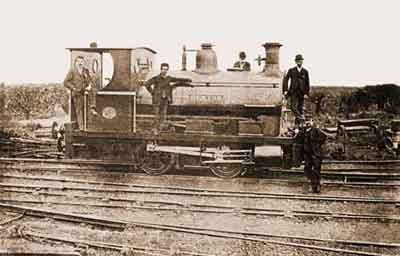
0-4-0 saddle tank locomotive 'Denton'.
Liverpool was an 0-4-0 saddle tank locomotive with an open cab, a rectangular water tank over the boiler and a prominent steam dome mounted over the firebox. Its cylinders were 14 inches in diameter and the stroke was 1 foot 10 inches. This locomotive was built by Henry Hughes and Co of Falcon Works, Loughborough, Leicestershire, possibly in the late 1860s. It seems that it first came into the ownership of Isaac Watt Boulton (1823-1899). He was the founder of Boulton’s Siding, a locomotive hire business. In Feb 1874 he sold it for £650 to Messrs Clayton & Brooke of Norbury Colliery. This coal mine was situated between Hazel Grove and High Lane, Cheshire (Grid Ref. SJ938855). Norbury Colliery closed in early 1892 and sales were held to dispose of the assets. On the 13-14 Jun 1892 the sale included two locomotives and it is known that a representative of the Denton Colliery Co Ltd was in attendance and that this company was one of the principal buyers. It was at this sale that the Denton Colliery Co Ltd purchased the Henry Hughes locomotive known as ‘Liverpool’.
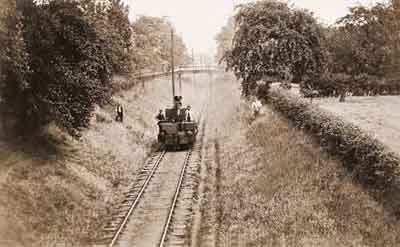
Denton Colliery Tramway, early 20th century.
This view is looking east towards Denton Colliery from Hyde Hall Bridge. The locomotive heading towards Denton Colliery is the 0-4-0 saddle tank locomotive, ‘Liverpool’.
Credit: A Arrowsmith.
Three locomotives » Locomotives
The four-wheeled waggons used to carry the coal were called bogies (hence the colloquial name of the tramway) and they would have had drop-down side doors. Up to 1883 Denton Colliery Company would have used its own private coal waggons that were permitted onto the London & North Western Railway (LNWR). Nevertheless, in 1883 the LNWR Company introduced a special class of 8-ton capacity waggon for coal traffic having high sides and fitted with side and floor doors. However, it seems that it then became railway company policy to permit private-owner waggons to be used alongside the new railway-company waggons. Because of this policy it is likely that from 1883 both Denton Colliery coal waggons and LNWR coal waggons were in use on Denton Colliery Tramway.
Coal waggon No.178 and other waggons » Waggons
History
By 1848 (NoteThe map shown below, dated 1848, shows a tramway between Denton Colliery and North Reddish.) the private Denton Colliery Tramway had opened and it remained operational until 1926.
Nevertheless, there is evidence that it could have opened in 1845/46. In spite of being a private tramway, was it wholly owned by the colliery proprietor or did the LNWR Company
have a financial stake in it as well? Likewise, did employees of the railway company help with its maintenance. The answers to these questions are obscure.
The 1901 census may cast a little light on this question but there is still considerable uncertainty.
At this time, Thomas Bennett, aged 37 years, was a Lurryman for a Railway Company who was living at the Gamekeeper's House, 1 Reddish Vale (at the bottom of Ross Lave Ln), Denton.
The name of the railway company was not recorded but the location of this house suggests that he was an employee of the LNWR Company.
This house was close to both the railway main line and the tramway. This means that he may have been employed by the railway company to carry goods, by road, to and from either the main line
or the tramway. At this time, a neighbour at 8 Reddish Vale was William E Bennett, aged 30 years, who was a Platelayer on a Railway.
Similarly, he was employed by a railway company and he could have worked on either the railway main line or the tramway.
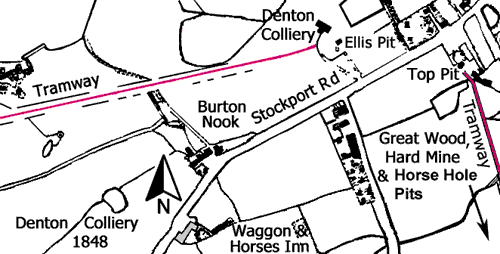
Denton Colliery and Tramway, 1848.
In contrast to the above map of 1848, newspapers recorded that the private railway (Denton Colliery Tramway) between Denton Colliery and the Stockport and Guide Bridge line was opened on the 7 Sep 1853 (NoteThomas Middleton, (1936), The History of Denton and Haughton.). Newspapers reported that at the opening two large marquees were erected at the terminus (Denton Colliery), and 2,000 guests assembled. At four o' clock in the afternoon several waggons, gaily decorated, containing Mr, Mrs and Miss Fletcher (that is, Jacob Fletcher Fletcher, his wife Anne née Fisher and their daughter, Charlotte Anne) and 60 of a company proceeded down the line (to North Reddish). After the return there was a splendid banquet and 'the colliers were regaled with good roast beef.' The newspaper reports are in contrast to the map of 1848, which shows the tramway. A possible explanation is that when the tramway first opened waggons were horse hauled along it and the celebration in 1853 recorded it being upgraded to locomotive hauled. Also compare this date of 7 Sep 1853 with the date when Charlotte Anne Fletcher laid the foundation stone of St Lawrence's School, Denton, which was on the 13 Oct 1853.
On the 1 May 1926 coal owners locked out miners throughout Britain when they rejected wage cuts recommended by the Samuel Commission. Consequently, on the 3 May 1926 the General Council of the Trade Union Congress (TUC) called some 1½ million workers out on strike (the General Strike) in support of coal miners. The TUC called the strike off on the 12 May 1926 but angry miners stayed locked out for a further six months until they were forced back with wage reductions and longer hours. During the miners' strike it was impossible to maintain the underground workings and many mines, including Denton Colliery, were damaged by flooding never to reopen. The company went into voluntary liquidation in 1929/30.
Following closure of the tramway, the bridges were dismantled and the brickwork was robbed. The rails remained in position until around 1938/39 when they were lifted for scrap and it was said at the time that this was part of the effort towards the impending World War II. The sleepers were left in place and over the years these were gradually lifted and put to other use. At the colliery end of the tramway, the remaining sleepers were lifted for the VE Day celebrations in 1945 and burned on the bonfire held in the colliery yard by the entrance to the Colliery Fields.
The fate of the viaduct at the Reddish end of the tramway is uncertain. It is understood that it was still extant during World War II but the date of its demolition is unknown.
The Route Described
The tramway was constructed on an east-northeast to west-southwest alignment and its length, between Denton Colliery and the main line of the LNWR
in Reddish was approximately 1 mile 585 yards. There was also an extension to Top Pit, Great Wood, Horse Hole and Hard Mine Pits on the opposite side of Stockport Rd,
with a level crossing on the road. This extension was originally about 622-yard long but in the early years of the 20th century it was truncated to about 407 yards.
This truncation might have been brought about by Great Wood Pit becoming a pumping station for mine drainage purposes.
Today it is no longer possible to walk the length of the tramway, as sections have been lost due to housing in Denton and the construction of the M60 motorway. Other sections are impassable. If the clock could be turned back to the turn of the 20th century, a journey along the tramway would have been an enjoyable event through countryside.
Please use the Scrollbar to pan over the map of Denton Colliery Tramway
Starting at Denton Colliery, with its many sidings and buildings, the tramway was pleasantly rural throughout its length. At 550 yards the tramway crossed a substantial embankment about 263 yards long, below which a stream was culverted. Immediately to the south of this, was Horse Close Wood and due to a profusion of bluebells in spring this was also known as Bluebell Wood. The stream reappeared in the wood to flow through it before leaving to find its way into the river Tame. At the end of the embankment, the tramway passed through the wooded grounds of Hyde Hall (late 16th century). Here there was an elegant wooden footbridge that was provided to maintain a connection to the grounds of the hall lying to the south of the tramway.
On leaving the Hyde Hall there was an accommodation bridge that upheld a right of way for a short Ln between Hyde Hall and fields lying to the south.
At 1,249 yards the tramway passed below the ancient Ross Lave Ln (formerly Consterdine Ln) at an acute angle, which required the provision of a skew bridge. Here there was a small yard with a short siding on the north side of the tramway. This siding could only be accessed from the Reddish side and it is possible that from time-to-time it was used to convey general goods from Reddish to Ross Lave Ln from where they could be carted to Hyde Hall and into Denton via Town Ln. It is equally possible that farm produce and general goods from Hyde Hall and south west Denton (known as The City) could have been transported to Reddish.
Beyond Ross Lave Ln the tramway passed through fields and at 1,632 yards there was an accommodation bridge that upheld a right of way for a short lane between Ross Lave Ln and fields lying to the north. After passing through another field, the tramway curved smoothly to the right to arrive at Denton Wood, which was situated in the valley of a stream that established three kinds of boundary, viz, the township boundary between Denton and Reddish, the new county boundary between Lancashire and Cheshire and the boundary of Poor Law Unions. To the south of the tramway, at the edge of the wood, there was a 57-yard long section of the Beat Bank Canal that was abandoned in 1798 by the Ashton Canal Company before completion.
In order to span the valley, a viaduct was built but unfortunately there are no known records or photographs of this structure. All that has survived is a ruinous red-brick abutment on the Denton side. The length of this viaduct is unknown but it has been estimated that it could have been upwards of 120-yard long. The type of viaduct built is unknown; it could have been either a brick viaduct of arched construction, the number of arches being unknown, or it could have been an iron-girder structure with brick abutments at each end and possibly two piers to support the span. On the viaduct, or just beyond it, on the north side, there was a small building of unknown purpose.
On leaving the viaduct the tramway immediately entered the Denton Colliery Sidings and Coal Wharf. Here there was a complex of sidings with two connections to the LNWR, both of which were in the Stockport direction. There was also a signal box used to control trains entering and leaving the sidings.
In addition to the sidings there was a setted access lane leading to Mill Ln in North Reddish; the purpose of which was to facilitate the distribution of coal by road transport. From the sidings, this lane immediately crossed a dual-purpose bridge built with engineering bricks, the parapets being surmounted with substantial coping stones. This bridge carried both the LNWR and the access lane over the Sheffield and Midland Joint Railway at a skew angle.
 |
 |
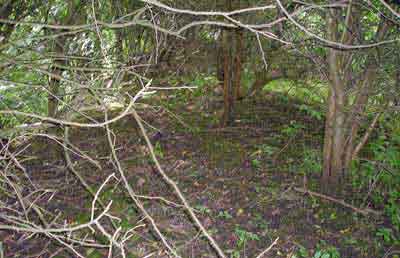
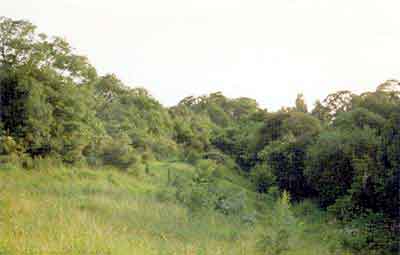
The top of the tramway embankment looking west towards Hyde Hall. Horse Close Wood is to the left. |
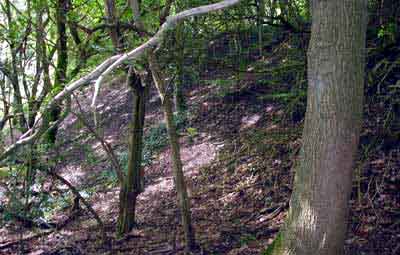
The south side of the tramway embankment looking west towards Hyde Hall. Horse Close Wood is to the left. |
 |
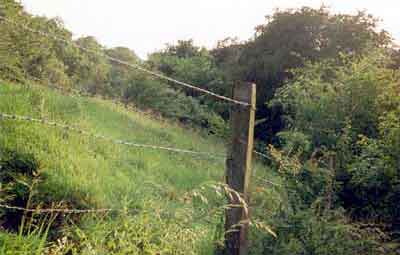 |
| The north side of the tramway embankment looking west towards Hyde Hall. | The north side of the tramway embankment looking west towards Hyde Hall. |
 |
 |
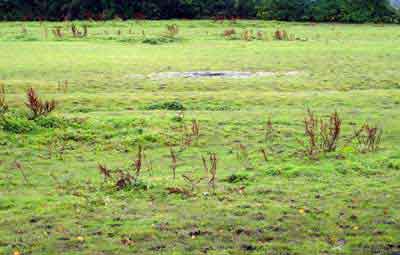
The view looking south across the line of the tramway from Ross Lave Ln. Hyde Hall is off the picture to the left. |
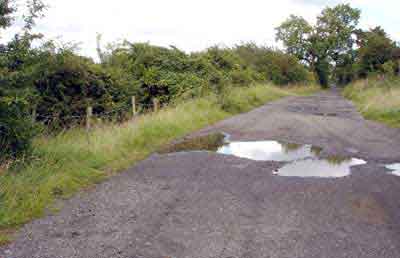
The site of Ross Lave Lane Bridge and siding. This view is looking along Ross Lave Ln towards Hyde Hall and the fence on the left indicates the site of the bridge over the lane. |
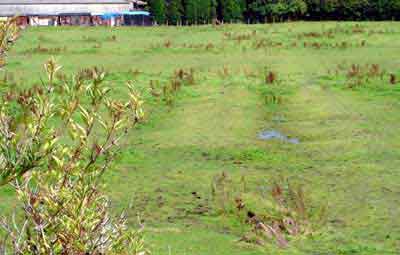 |
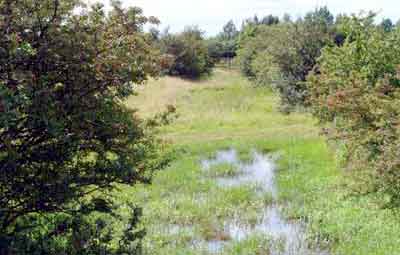 |
The view looking east along the tramway from Ross Lave Ln. Part of Hyde Hall is visible, top left. |
The view looking west along the tramway from Ross Lave Ln. |
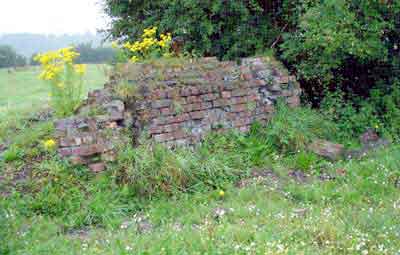 |
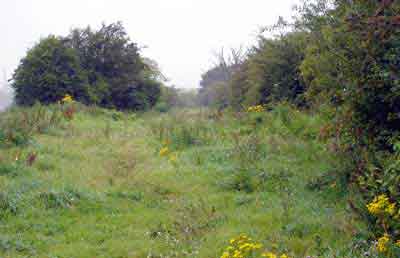 |
| The southern abutment of the accommodation bridge that formerly connected fields to Ross Lave Ln. | Looking west along the tramway from a point close to the site of the accommodation bridge abutment. |
 |
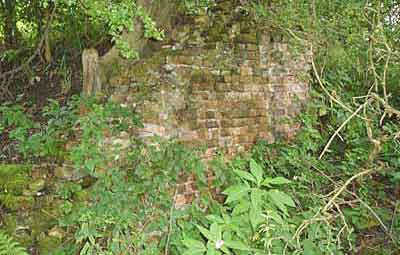 |
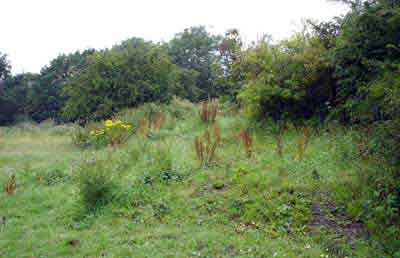
| Looking west along the tramway towards Denton Wood and the site of the viaduct. | The eastern (Denton) abutment of the viaduct. |
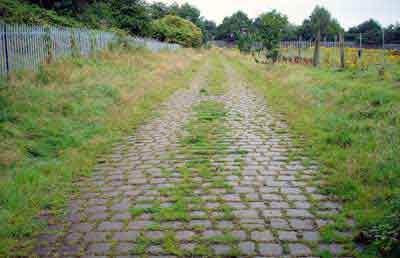 |
The access lane to Denton Colliery Sidings and Coal Wharf looking from Mill Ln, North Reddish. |
