Coal was principally used for steam/electricity generation and for heating/lighting/cooking purposes using town gas made from coal. Town gas was a mixture of carbon monoxide, hydrogen and methane.
Coal was formed by a natural chemical progression known as lithification, which is the term given to the geological process by which sediment is transformed into stone. At first, the dead matter accumulates as a deposit of peat on the surface, which is then buried beneath layers of younger sediment. With increasing depths of burial, the pressure and temperature rise and over a long period of time the peat is converted into coal.
As a result of subsequent folding and faulting of strata, coal seams occur at varying depths from the surface. They can occur at the surface as outcrops or at considerable depths. For example, the shaft at Parsonage Colliery at Westleigh, Lancashire, was sunk to a depth of around 1,000 yards but the Arley Mine (seam) being worked there continued downwards at a gradient of 1 in 5 and this was worked to a depth of around 1,376 yards (4,128 feet). In Britain coal seams can vary in thickness from a few inches up to around 12 feet, although exceptionally thicker seams up to around 16 feet are known.
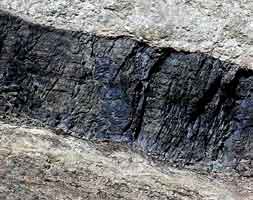
Coal seam with a gradient of about 1 in 3.8.
Under suitable geological conditions dead matter is formed successively into:
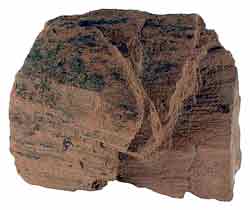
Lignite or brown coal.
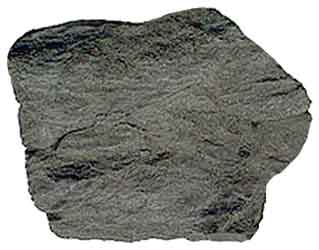 Dark-grey sub-bituminous coal.
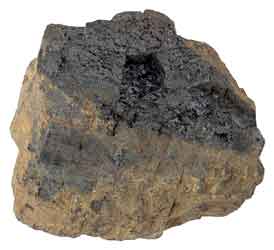 Dark-brown sub-bituminous coal.
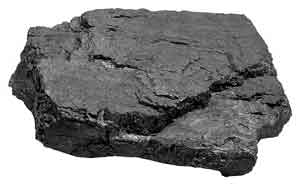 Bituminous coal.
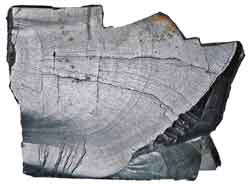 Cannel coal.
Coal was formed during the Carboniferous Period, which was from about 358.9 to about 298.9 million years ago. It was mainly formed from tree-like plants that grew in warm humid swamps:
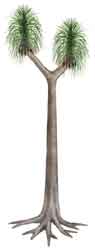 Sigillaria tree.
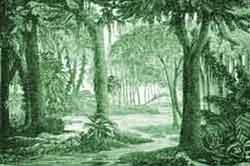 Carboniferous forest.
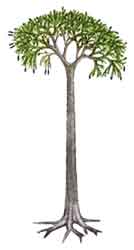 Giant club moss.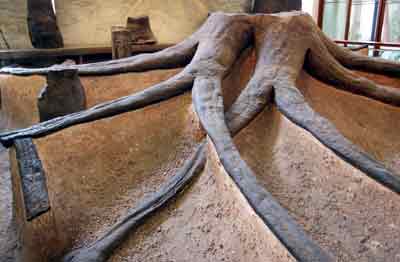
Stigmaria root system in Manchester Museum.
This fossil was found in a quarry at Clayton, Bradford, Yorkshire, in 1886.
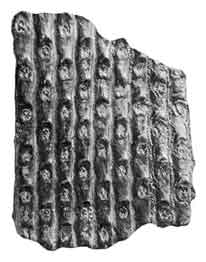
Stigmaria (Sigillaria bark) fossil.
During the Carboniferous Period early conifer trees began to appear that were cone-bearing seed plants closely related to seed plants called Cordaites, which are now extinct.
Four families of plants that have survived are:
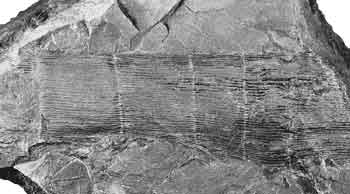
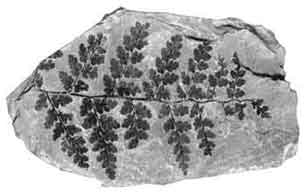
Coal miners found plant fossils during their work and sometimes they would take these home to show their families. The two fossils illustrated below are typical of those found by miners.
Above left: Calamite. A genus of extinct tree-like horsetails to which present-day horsetails (genus Equisetaceae) are closely related. Calamites had distinct nodes, similar to horsetails, and similarly their branches and leaves emerged in whorls from those nodes. Their upright stems were woody and connected by an underground runner system. Above right: Sphenopteris or seed fern. These ferns varied in size from small plants to trees and they were among the earliest seed-bearing plants but they have no descendants.
Geological contexts for coal formation
Overlying the coal strata is the Aegiranum Marine Band which is mostly mudstone containing marine fossils.
It is a very fine-grained sedimentary rock consisting of a mixture of clay and silt-sized particles.
The presence of marine fossils in the Aegiranum Marine Band confirms that the sea ultimately flooded the swamplands of the Carboniferous Period.
Underlying coal strata is seatearth which is a sedimentary rock representing the soil that supported the vegetation from which the coal was formed. It contains traces of roots and rootlets. Seatearth can also consist of fireclay which is another form of mudstone.